My younger sister, whom we famously call Nurse Tee, came to visit. It’s always nice to see family members once in a blue moon. Life has a funny way of scattering everyone across different cities until seeing your own sibling starts to feel like a scheduled diplomatic visit.
And as the wicked older brother that I am, I gave Nurse Tee one rule for her stay: she had to read twenty pages of the book I gave her before eating her next meal. Every twenty pages earned her food. No reading, no food. Some people show love through affection; I prefer to sprinkle in some starvation and intellectual development.
The book was Same as Ever by Morgan Housel. It’s one of those books that can change how you think, and sometimes, changing your life starts with changing your mindset. We agreed that as she read, we would discuss any part she found interesting.
Then Sunday came. Mimie wanted us to go out for breakfast, but I would have preferred to stay home because I had about ten Codex agents running, and Cursor had spent the morning misbehaving. I needed to babysit these AI agents and figure out why they were getting dumber by the day. But marriage comes with sacrifices, so I grudgingly closed my laptop as Mimie dragged me out.

We got to the restaurant…
While waiting for the food to come, Mimie turned to Nurse Tee and asked, “So, how’s the book going?”
But before Nurse Tee could answer, a tiny voice came from the other side of the table.
“Numberblocks!”
That was Desi, my toddler. Numberblocks is her favourite animation, and she knows that restaurants are one of the few places where she has enough negotiating power to demand it. A few days earlier, Mimie and I had agreed that we would stop letting her watch anything while eating out because we didn’t want her to get used to needing a screen at every restaurant.
But when she asked, Mimie and I looked at each other and reached a unanimous decision without saying a word. We would rather let her watch Numberblocks than spend the next hour singing “baby shark doo doo” for her. When you go out with a toddler, you have two choices: give them entertainment or become the entertainment.
We chose peace. Numberblocks came on, and everywhere went quiet.
Back to the question.
Then Nurse Tee started gisting us…
She pointed to a chapter in the book called “Expectations and Reality”.
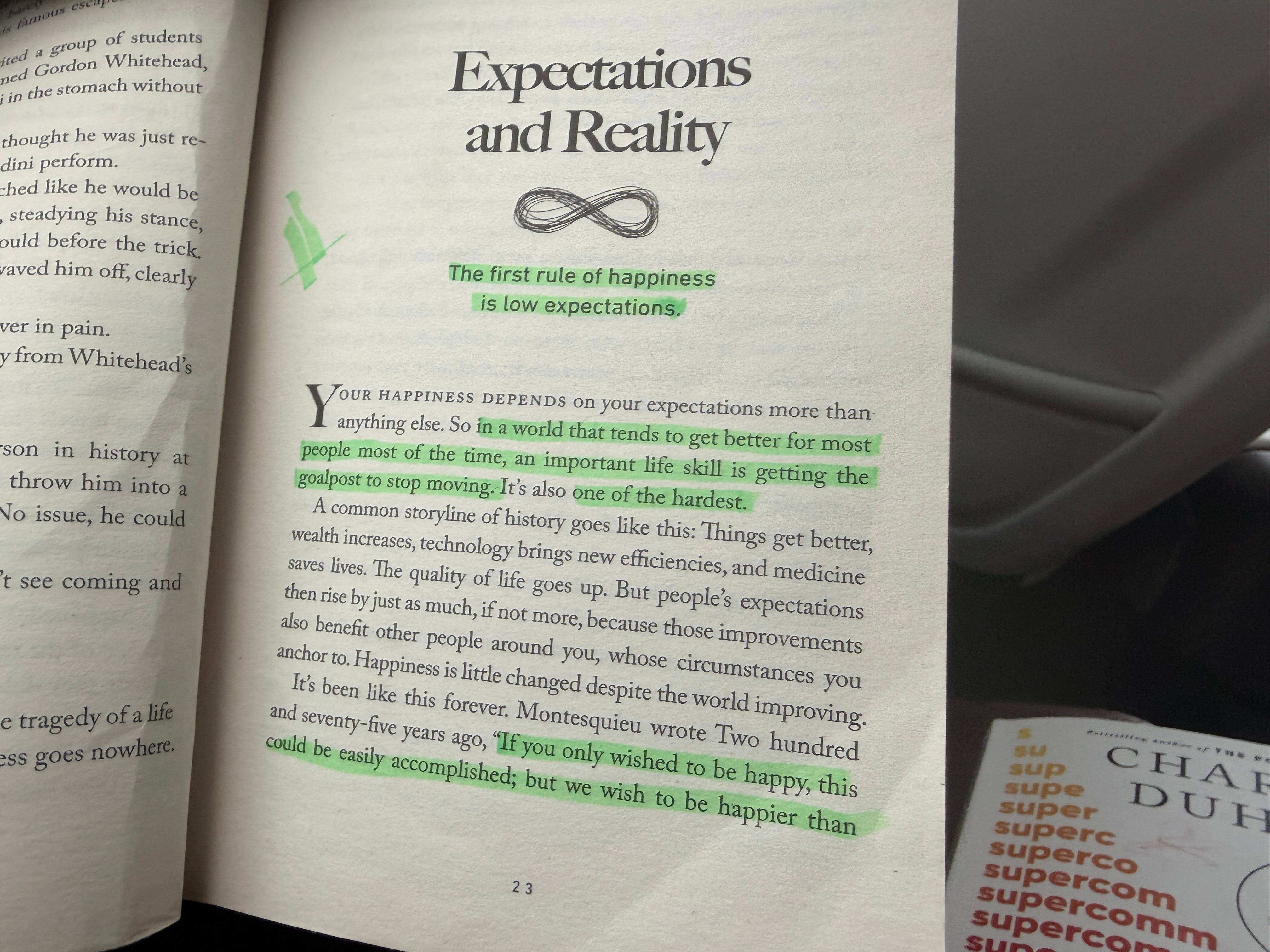
It contained a line from Charlie Munger that Morgan Housel used in the book: “The first rule of a happy life is low expectations.”
And in other words, it summarily means people who don’t expect much from life tend to be generally happier. And our expectations increase based on our exposure.
It was my favourite part when I read the book. However, I wanted to hear Nurse Tee’s interpretation, and she had a fresh example from the Emirates flight that brought her to us.
On her way to visit us, she flew Emirates. To reach her economy seat, she had to pass through first class and business class. This means that before she could sit down, Emirates had shown her another version of life: the large seats, the extra space, and the comfort. Then she continued walking until she reached economy, where she had to squeeze into a row of three.
The two passengers beside her kept getting up to use the toilet, which meant she had to stand each time. Throughout the flight, one thought kept running through her mind: “I must make it in life so I can sit in business class.”

If she had entered the plane through another door and gone straight to economy, the seat might have been fine. She would still have been cramped, but cramped without a higher expectation. Instead, business class followed her into economy and sat with her for the entire flight.
Nothing about her seat had changed. Her expectation had.
At this point, Mimie chimed in…
“ There’s a problematic side to increasing expectations" she said.
Once you see something better, your brain updates its definition of “normal”. You get a better job, then discover someone your age earning five times more. You move into a nicer apartment, visit someone whose bathroom is the size of your living room, and return home wondering why your landlord hates you.
Nothing has been taken away from you. Your life might even be better than it was a few years ago, but your expectations have risen again above your reality. This is how someone can be doing better in almost every objective sense and still sit down one evening wondering, “What have I even been doing with my life?” Psyche….. It’s because you expect too much from life, or yourself.
“So, should we keep our expectations low?” Nurse Tee asked.
I didn’t have a clean answer for her. If happiness were the only thing we cared about, then perhaps we should expect nothing from life. So that anything good that happens would feel like a bonus. But that also sounds like a convenient excuse to lie down, breathe oxygen and congratulate yourself for breathing.
The opposite approach doesn’t sound much better. If your expectations increase each time your reality improves, you’ll never feel like you’ve arrived anywhere. You’ll get what you wanted, enjoy it for three business days, then find a newer and more expensive thing to disturb yourself about.

I had experienced something similar…
I told Nurse Tee about the first time I travelled from Ile-Ife to Lagos. I had spent the first twenty years of my life in that small town called Ife and even went to university there. Life seemed fine because I didn’t know I was missing anything; my expectations of life were low.
Then I visited Lagos. I saw Victoria Island, large houses, expensive restaurants and a Rolls-Royce outside Quilox. When I returned, Ife suddenly looked different. The roads felt smaller, the houses looked older, and things that had been normal two weeks earlier began to annoy me.
Nothing had changed in Ife. Lagos had only increased my expectations.
That trip made me less happy about my reality, but the same discomfort eventually pushed me to leave Ife. So the exposure gave me motivation and dissatisfaction inside the same package. Buy one, get one free.
This was why I couldn’t tell Nurse Tee that seeing business class was a bad thing. That short walk gave her a new ambition and ruined part of her flight. Maybe it will motivate her to fly business class one day. But before that time comes, she’d constantly be unhappy anytime she flies economy, unless, of course, she lowers her expectations, which is easier said than done.
There’s always another cabin…
Even if Nurse Tee eventually starts flying business class, there’s a good chance she’ll walk past first class, look inside and begin another round of “I must make it in life”.
By this point, I wasn’t sure if the conversation had answered our question or created a new one. Low expectations might make us happier, but higher expectations sometimes get us moving. The same expectation can give you something to chase and make your present life feel inadequate while you chase it.
We didn’t solve the problem at breakfast. We only agreed that knowing what is possible can motivate you and frustrate you; you choose your poison.
Meanwhile, Desi sat quietly watching Numberblocks. She didn’t really care about business class, economy, expectations, reality or Morgan Housel. She asked for one thing, received it and became the happiest person at the table. According to the formula, she won.
Nurse Tee, on the other hand, now has business class living in her head rent-free. She also had another twenty pages to read before her next meal. Low expectations or not, house rules are house rules.